Prediction markets and sovereign risk
Do prediction-market prices anticipate movements in sovereign risk?
The context
Sovereign risk in Latin America moves with politics: a close election, a cabinet crisis or a shift in monetary policy can move spreads more than any macro data release. The problem is measuring those political expectations in real time — polls are infrequent and arrive with days of lag, and analyst readings are hard to quantify and compare.
Prediction markets offer an alternative: on platforms like Polymarket, thousands of participants price the probability of concrete events with real money — who wins an election, whether a central bank raises rates, whether there is an impeachment — around the clock, every day. If those prices genuinely aggregate information, they should anticipate movements in the assets that depend on those same events: CDS, the EMBI and the exchange rate.
The project evaluates this with three pieces: (i) a daily database of every Polymarket market relevant to 5 economies in the region — Brazil, Chile, Colombia, Mexico and Peru — since 2023, filtered by volume and trading time; (ii) daily indices of political and macro risk by country, built separately; and (iii) the econometric assessment of whether those indices anticipate sovereign risk.
How it is built
The database is assembled from Polymarket's public APIs: metadata and daily prices for each market, with explicit inclusion criteria (minimum volume, at least 30 days of trading) and each market classified into a political or macro channel according to the event it prices. That database is merged with the daily prices of 5-year CDS, EMBI, the exchange rate and global controls — VIX, the dollar, Treasury yields — to isolate what is local signal from what is global risk appetite.
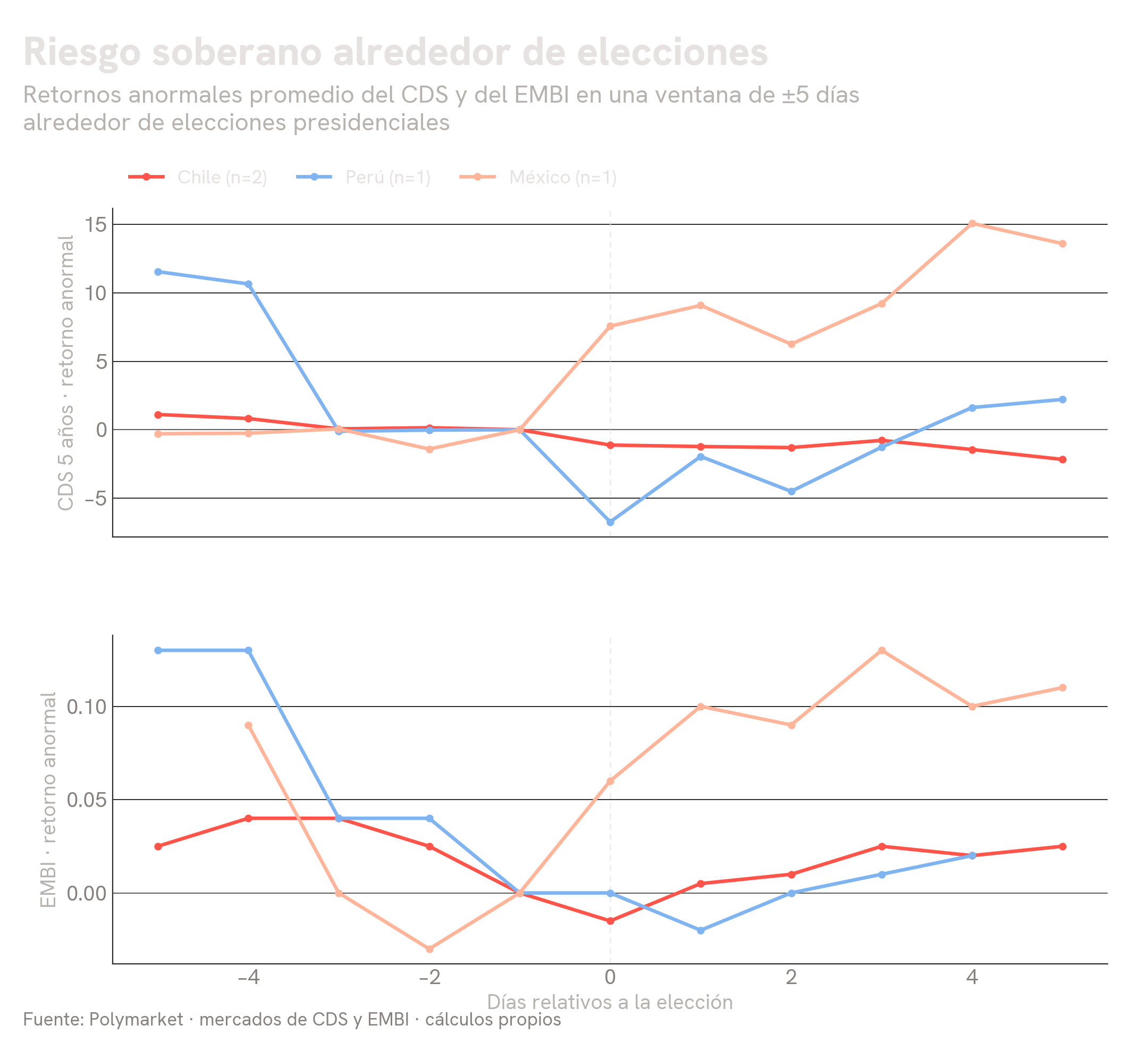
Three econometric exercises run over the panel: event studies in ±5-day windows, Jordà-style local projections to estimate the dynamic response of risk, and quantile regressions for the tails. The event study accompanying this section shows the first piece: the average reaction of CDS and the EMBI around presidential elections.
What the data show
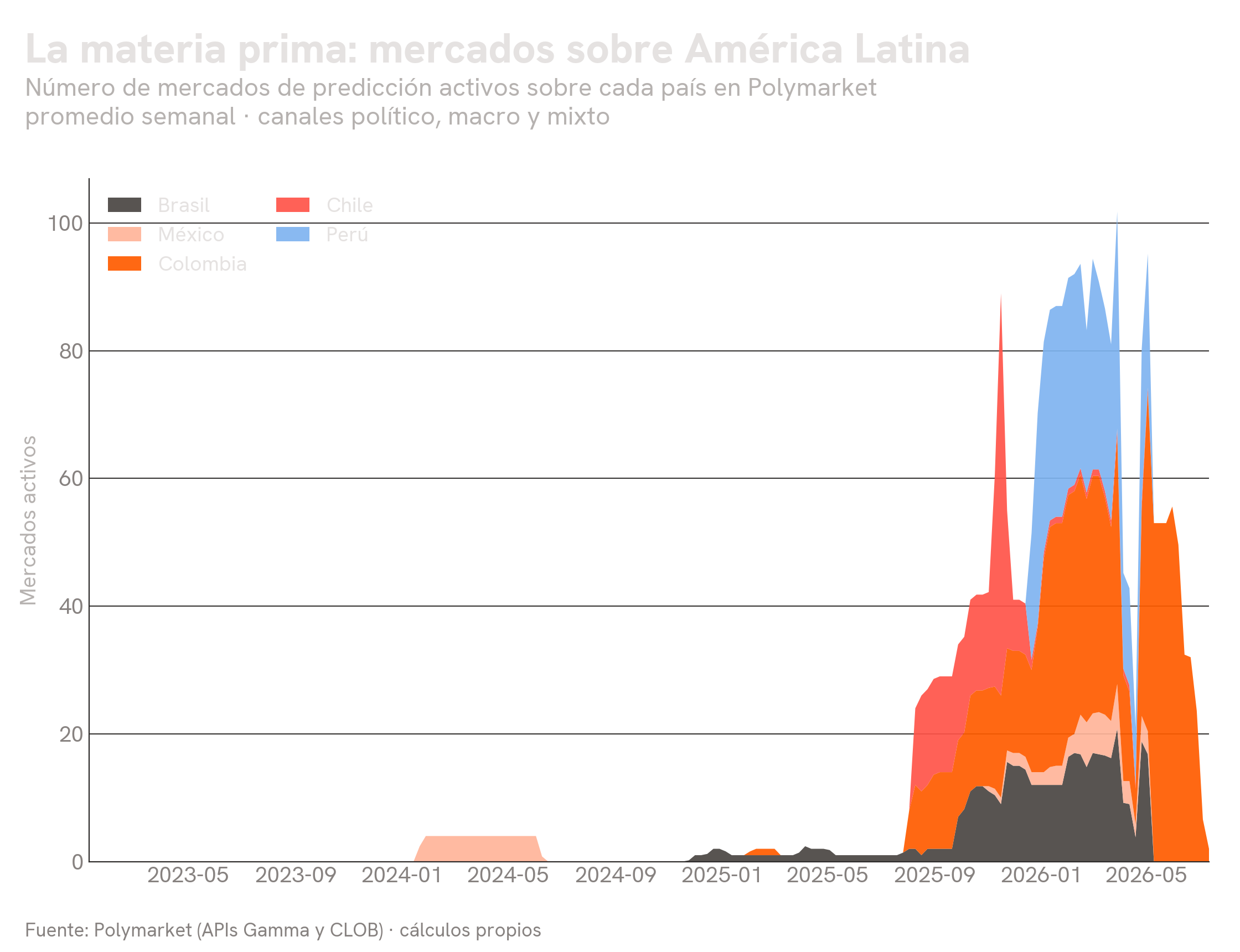
In electoral windows sovereign risk moves systematically, and the priced probabilities anticipate the direction of that movement with an accuracy close to 75%. The political channel is more informative than the macro one: markets on elections and presidents concentrate the volume and liquidity, and that is where the predictive content is clearest. The figure in this section shows the raw material behind those results: the number of active markets on each country, which multiplies around electoral cycles — the project takes advantage of precisely those dense windows.
Two channels, not one
Separating the political channel from the macro one is not a technical detail. A market on a presidential election prices a different risk than a market on the next rate decision, and mixing them would dilute both signals. The analysis treats them as separate indices by country, and the results confirm the decision: the pass-through to sovereign risk has different magnitudes and horizons in each channel, with subchannels — monetary policy, inflation expectations — that are explored one by one.
Future work
- Deepen the macro subchannels — monetary policy and inflation expectations — and the horizons of the local projections, with the growing 2026 sample.
Tools
Python end to end: cached scrapers for Polymarket's APIs (Gamma and CLOB), automatic classification of markets by channel, polars and pandas for the daily panel, and statsmodels and linearmodels for the event studies and local projections.
Scope: the available history of these markets is short and their liquidity varies across events and countries; the results should be read as preliminary. Sources: Polymarket · CDS and EMBI markets · exchange rate and global controls.
Interested in this topic?
Let's talk about prediction markets, sovereign risk or collaborations.