News-based Economic Sentiment Index
Can the tone of thousands of news articles anticipate economic activity?
The context
Activity indicators arrive with a lag: a country's monthly figure is published weeks after the month closes, and quarterly GDP, months later. Between one data release and the next, however, the public conversation does not stop: every day thousands of news articles register optimism or pessimism about the economy. The question of this project is whether that tone can be turned into a quantitative indicator that can be read before official statistics.
The idea comes from the text-as-data literature: the aggregate tone of the press correlates with spending and investment decisions and, measured with enough article volume, works as a thermometer of expectations. Applying it to Latin America requires solving a problem of its own: international press coverage is very uneven across countries, and an index built without controlling for that would confuse a lack of news with pessimism.
The project turns it into three deliverables: (i) a monthly economic sentiment index for 8 economies in the region since 2015, built with the same rules for all of them; (ii) a PPP-GDP-weighted regional aggregate, comparable with the monthly activity indicators; and (iii) a battery of validation against each country's official statistics.
How it is built
The input is GDELT, the open database that indexes more than 140,000 press sources around the world: each article about a country's economy receives a tone score, and the scores are aggregated by country and month, distinguishing economic news from political news. A country-month with few news articles does not enter the index — the minimum coverage thresholds prevent the noise of empty months from being read as signal. Each series is standardized against its own history, so that the index is read in deviations from each country's normal tone.
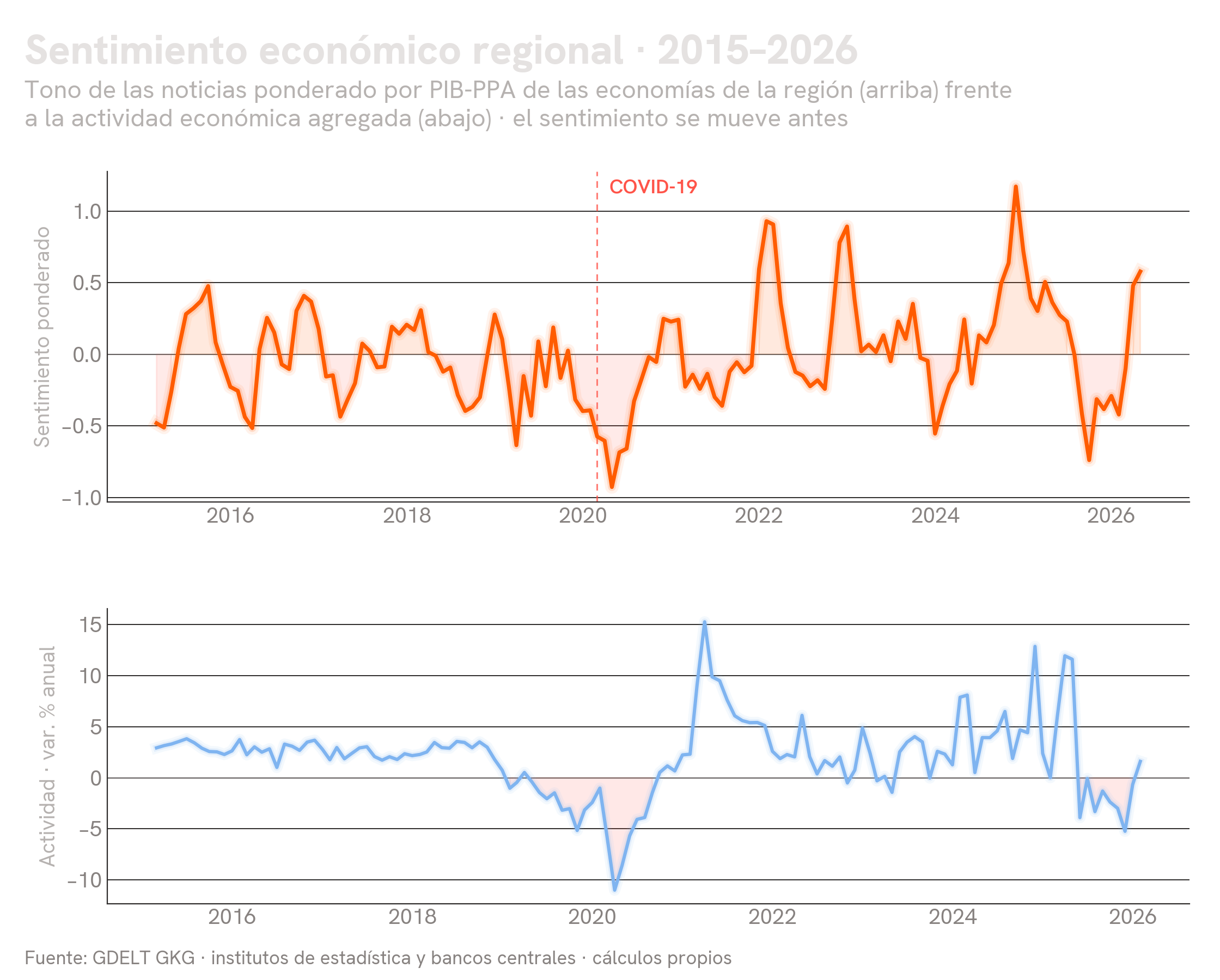
The regional aggregate weights countries by their PPP GDP, redistributing the weights when a country does not have sufficient coverage. The figure accompanying this section shows the result: on top, regional sentiment; below, the aggregate economic activity of the same economies — sentiment moves first, and the major episodes (the COVID-19 collapse, the subsequent recovery) appear in both series.
What the data show
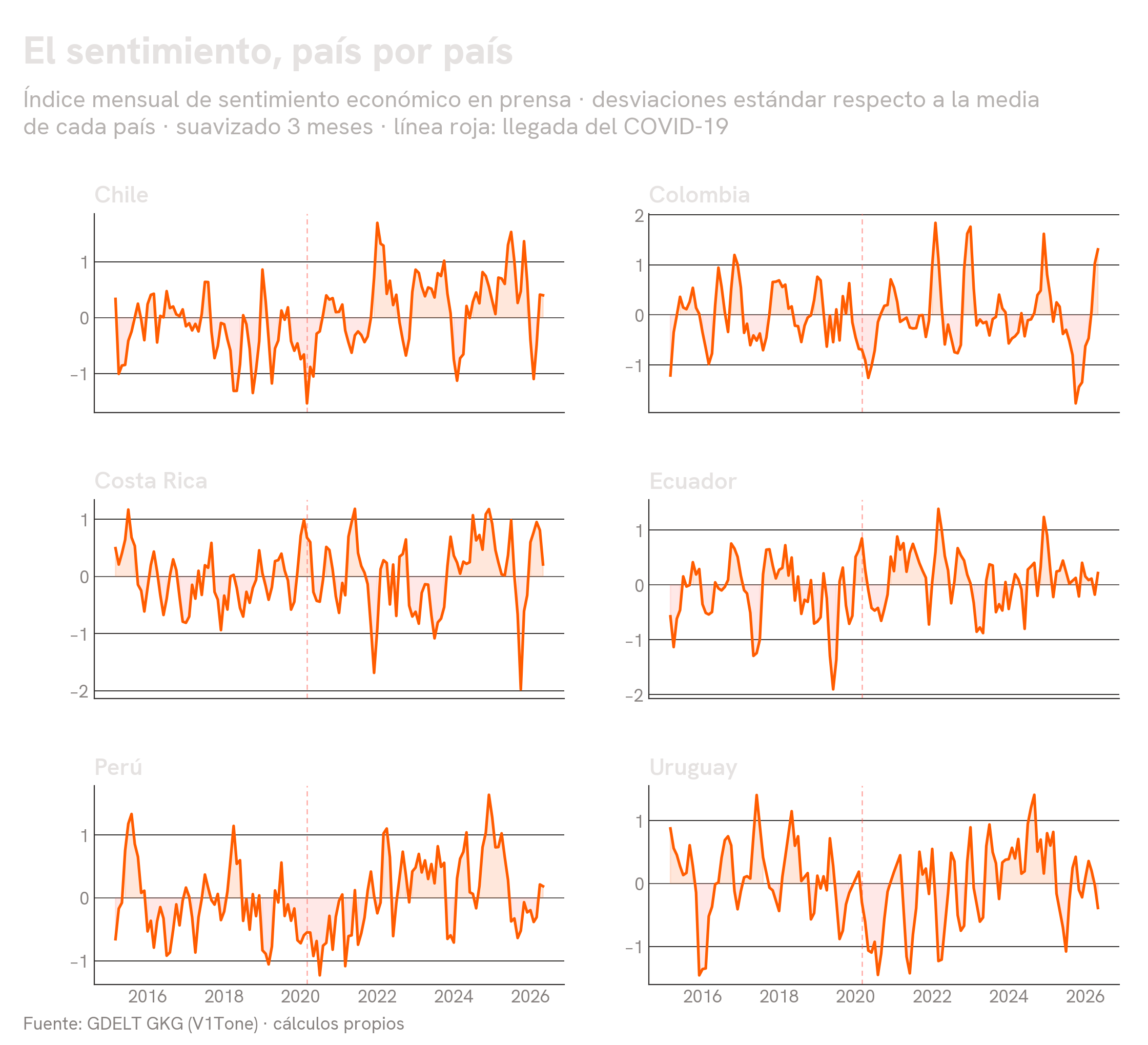
The panel in this section brings the index down to the country level: each economy already has its own sentiment index, built with the same rules, and there the heterogeneity that the aggregate hides appears. In countries with dense international press coverage the signal is clean and episodes are well identified: the social unrest, the electoral cycles and COVID-19 leave sharp marks. In countries with less coverage the series is noisier. The country-by-country validation tests point in the expected direction: in some economies the index anticipates the movements of the official activity indicator, and the signal is better where there is more news.
A single source, by design
During development, scraping tests were also run with Google News, which cover the most recent period with a larger volume of articles per country. But the two sources do not select the same news — GDELT mostly indexes international agency press, in more neutral language; Google News picks up more local press — and mixing them would introduce an artificial break in the series. For homogeneity, the index uses exclusively GDELT across the entire 2015–2026 period; the Google News tests remain as input for expanding coverage where the international press is scarce.
Future work
- Extend the index's coverage to more countries in the region, drawing on the country-level indices that are already built and tested.
Tools
Python for the entire pipeline: bulk download of GDELT (GKG and Doc API), scraping tests on Google News, tone scoring with specialized dictionaries, pandas for the panels and statsmodels for the statistical validation.
Scope: press sentiment is a complementary signal, not a substitute for official data; media coverage varies across countries and over time. Sources: GDELT · monthly activity indicators for each country.
Interested in this topic?
Let's talk about applied NLP, high-frequency indicators or collaborations.