Stablecoins: private money, public debt
When a digital dollar issued by a private company is backed by U.S. Treasury debt, every payment made with it is also a portfolio decision. That link — global payments mechanically connected to demand for Treasuries — is the most interesting macroeconomic story in digital money today.
This is not a crypto story
Payment stablecoins — think of tokens that promise to be worth exactly one dollar — work because their issuer holds reserves in safe U.S. assets, mainly short-term Treasuries. Under regulatory frameworks like the GENIUS Act, that backing is full and the coins pay no interest.
The consequence is mechanical and powerful: global demand for a means of payment turns into demand for U.S. public debt. If the world wants more stablecoins to transact with, issuers have to buy more Treasuries. The phenomenon stops being a fintech curiosity and becomes a matter of the international monetary system.
How big is "big"?
The question is not rhetorical: as we will see, the effects of this mechanism depend on the size of the market. The figure puts the scale on the table.
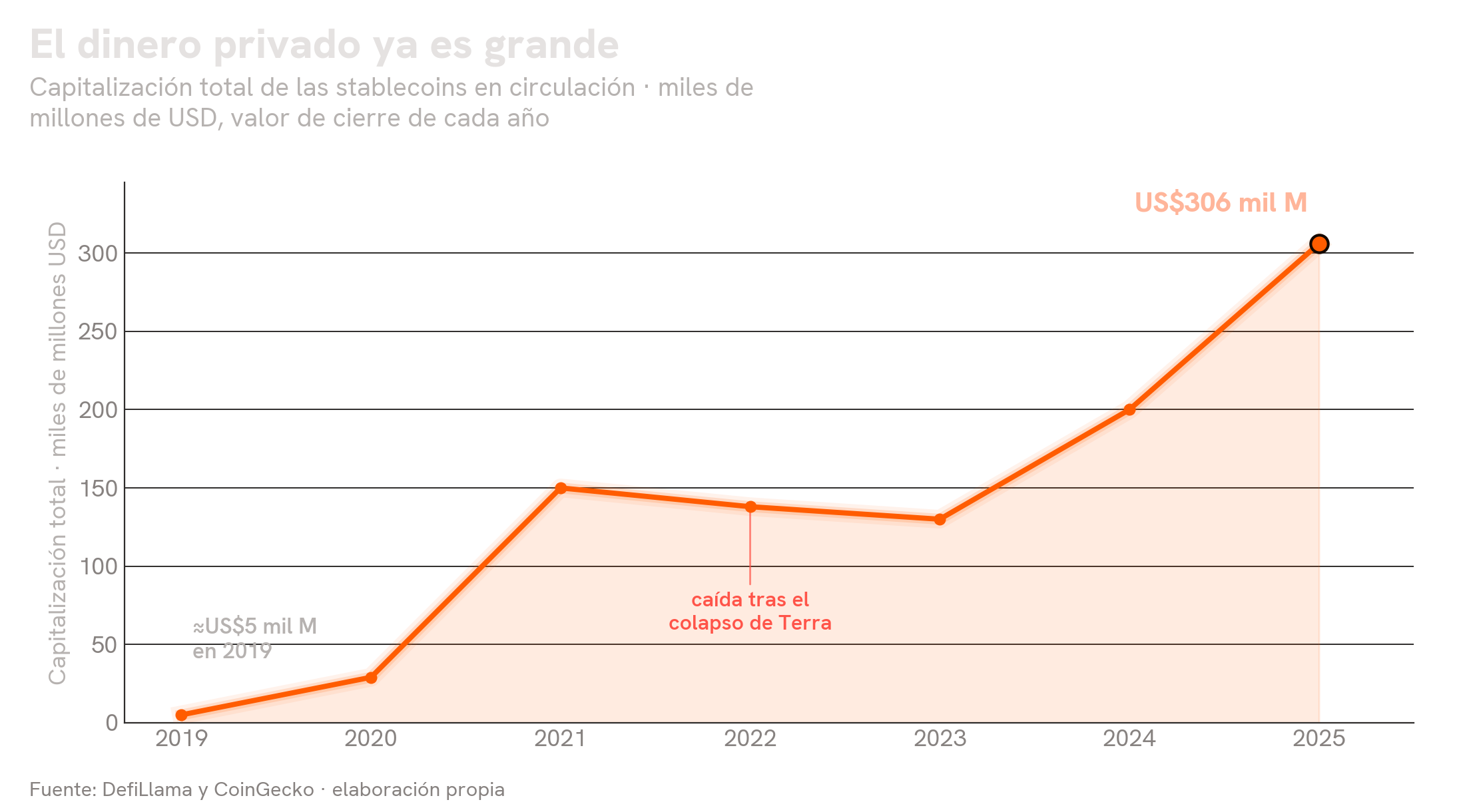
Three hundred and six billion is still small next to the roughly 28 trillion dollars of the Treasury market: that is why the channel is second-order today. The point is the slope, not the level — and the slope points upward.
The safe-asset channel
A recent ECB working paper — Ferrari Minesso and Siena (2026), “Private money and public debt: U.S. stablecoins and the global safe asset channel” — formalizes this mechanism and reaches results worth keeping on the radar:
- Benefits for the U.S.: the expansion of stablecoins widens the global footprint of the dollar and compresses risk-free yields — an additional source of “exorbitant privilege”.
- Costs for the U.S.: the real transmission of monetary policy weakens — part of the demand for its safe assets no longer responds to the Fed but to the global payment cycle.
- Non-linearity: at small capitalizations the effects are negligible; when the market grows, they increase disproportionately. The time to think about this is before it is big.
- Spillovers: the channel amplifies the transmission of shocks across countries — payment demand in one region moves the yields that discount assets in all the others.
Private money creation ends up moving demand for public debt. It is the old banking question — who creates money and with what backing? — with new protagonists.
The reading from emerging economies
For Latin America, the phenomenon has three fronts. First, de facto digital dollarization: if it becomes easier for residents to hold and transact digital dollars, demand for local currency and domestic bank deposits can erode — with consequences for bank funding and seigniorage. Second, capital flows: stablecoins reduce the friction of moving value across borders, which can accelerate both inflows and outflows in episodes of stress. Third, rate spillovers: if the safe-asset channel amplifies movements in U.S. yields, the region's external financing cost becomes more sensitive to a market it does not control.
None of this is a first-order problem in the region today — and that is precisely the window of opportunity: the non-linearity of the mechanism suggests that the rules should be written while the market is small.
What is worth watching closely
- The aggregate capitalization of stablecoins and the composition of their reserves — the size of the channel.
- Adoption in economies with an inflationary history — the room for digital dollarization.
- Comparative regulation (U.S., Europe, Latin America) — who writes the rules of private money.
- Episodes of depeg — each break of parity is a natural experiment on the soundness of the backing.
This topic will become a full research project in the portfolio; this note is the map of that agenda.
Reference: Ferrari Minesso, M. and Siena, D. (2026). Private money and public debt: U.S. stablecoins and the global safe asset channel. ECB Working Paper No. 3174. The figure uses market capitalization data from DefiLlama and CoinGecko (year-end closing value).