Geoeconomic fragmentation: what is at stake for Latin America
Trade, investment and value chains are reorganizing into geopolitically aligned blocs. For Latin America, the outcome is not written yet: it can be caught between two currents or become the connector both blocs need.
From globalization to blocs
The world economy is not deglobalizing: it is fragmenting. The difference matters. Deglobalization would mean less trade overall; geoeconomic fragmentation means that trade and investment reorganize by geopolitical affinity — countries trade increasingly with their allies and less and less with the opposing bloc.
Three catalysts accelerated the process. The pandemic exposed the fragility of supply chains optimized for cost alone. The war in Ukraine turned energy and food into strategic weapons. And since 2025, United States trade policy has made tariffs its preferred tool, prioritizing bilateral deals over the multilateral rules that ordered trade for decades.
Why the region has so much at stake
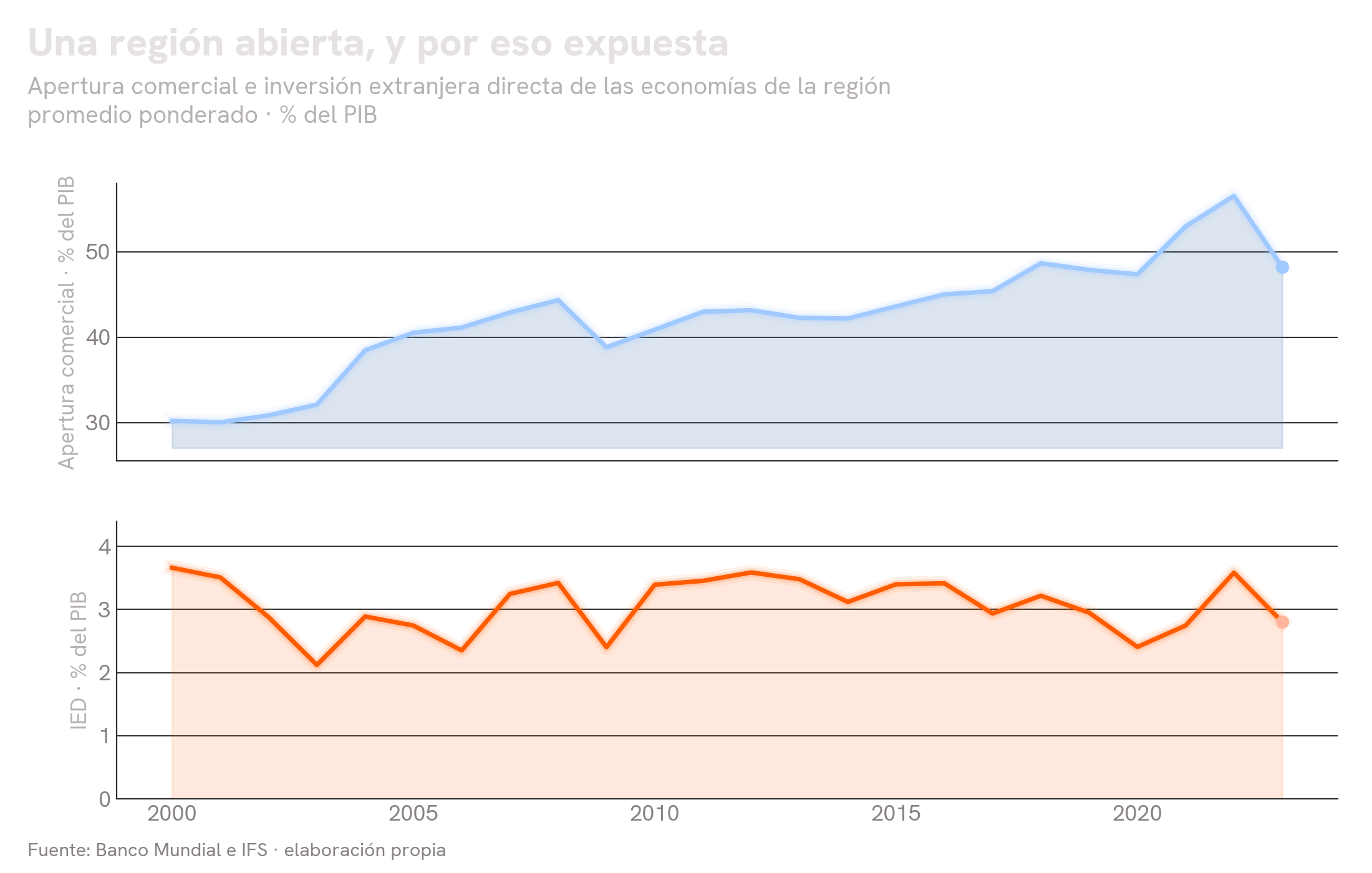
Exposure is not an opinion: it is a structural feature. The two series below measure how much of the regional economy depends on what happens beyond its borders.
What the data already show — and what they do not yet
Since the middle of the last decade, trade restrictions imposed on and by Latin America have been rising, and the region's participation in global value chains remains low. And yet, the striking thing about the series above is what they do not show: no abrupt break. Trade openness follows a long-term upward trend and FDI oscillates within its usual range — fragmentation has not yet appeared in the aggregates.
Fragmentation is, for now, more visible in policy announcements than in the flows. That gap between rhetoric and data is exactly what has to be monitored.
That balance is fragile. United States tariffs — in particular those that affect Mexico and Colombia — can shift the indicators in the short term, and the concentration of FDI in "aligned" countries is already a documented trend. For a region whose foreign investment goes in good part to extractive sectors, this adds a layer of risk on top of the already familiar volatility of commodities.
The dilemma: caught between two currents or a connector
Fragmentation also opens an opportunity that few regions have. If Latin American countries adopt a stance of strategic neutrality — trading with both blocs without aligning exclusively with either — the region can capture part of the reshuffling of value chains: nearshoring toward Mexico and Central America, critical minerals in the Southern Cone, food and energy across the continent.
But being a connector is not free. It demands infrastructure and logistics up to the task — and there the region remains behind: logistics performance indicators show persistent gaps in customs, infrastructure and operational capacity. Without those conditions, neutrality stays a mere declaration.
What it means for economic policy
- Diversify markets and products: dependence on few partners and few commodities is the main vulnerability in a world of blocs.
- Shield the macro frameworks: with external financing more uncertain, monetary, fiscal and financial credibility becomes the most valuable asset.
- Invest in logistics and infrastructure: it is the material condition for capturing nearshoring instead of merely watching it.
- Measure better and faster: traditional data arrive late for a process that moves at the pace of announcements; unconventional indicators can close that gap.
Geoeconomic fragmentation is not a future scenario: it is the environment in which the region already operates. The difference between suffering it and taking advantage of it lies in policy decisions being made now.
This note reflects my personal reading of work developed together with Carlos Giraldo, Iader Giraldo and Valeria Saldaña on trade and FDI in Latin America against the backdrop of geoeconomic fragmentation.