Dollarization: what the literature actually says
Few words carry as much debate in Latin American macroeconomics. After systematically reviewing the literature — from the currency substitution of the eighties to portfolio models and recent evidence — this is what we truly know about dollarization, and what we are still arguing about.
First, the terms
Dollarization is not a single thing. It is official (de jure) when the foreign currency is the only legal tender — Ecuador, El Salvador, Panama. It is de facto when it circulates alongside the local currency without being legal tender. And there is a third, less visible layer: price dollarization, where goods and contracts are quoted in dollars even though they are paid in local currency. Most of the countries in the region live with partial forms: dollar deposits and credit coexisting with local-currency instruments.
The finding that orders everything: hysteresis
Dollarization almost always originates from inflation: when the local currency stops being reliable as a store of value, agents migrate to the dollar. What is interesting — and what the literature documents insistently — is that it does not reverse when inflation subsides. That persistence has a name (hysteresis) and explanations: exchange-rate risk that remains alive, credibility that takes decades to rebuild, and shallow financial markets that offer no local-currency alternatives.
Inflation ignites dollarization; the lack of credibility and of markets keeps it burning long after inflation has gone out.
The minimum-variance portfolio framework (Ize and Levy-Yeyati) formalized this idea: equilibrium financial dollarization depends on the relative volatility of inflation against the real exchange rate. If inflation is more volatile than the exchange rate, dollarizing is the rational portfolio decision — not a cultural whim.
Hysteresis is not destiny
Persistence is real, but it is not a sentence. The figure below tracks the share of bank deposits in foreign currency across a dozen economies in the region over the last quarter-century, and shows two opposite stories coexisting in the same neighborhood.
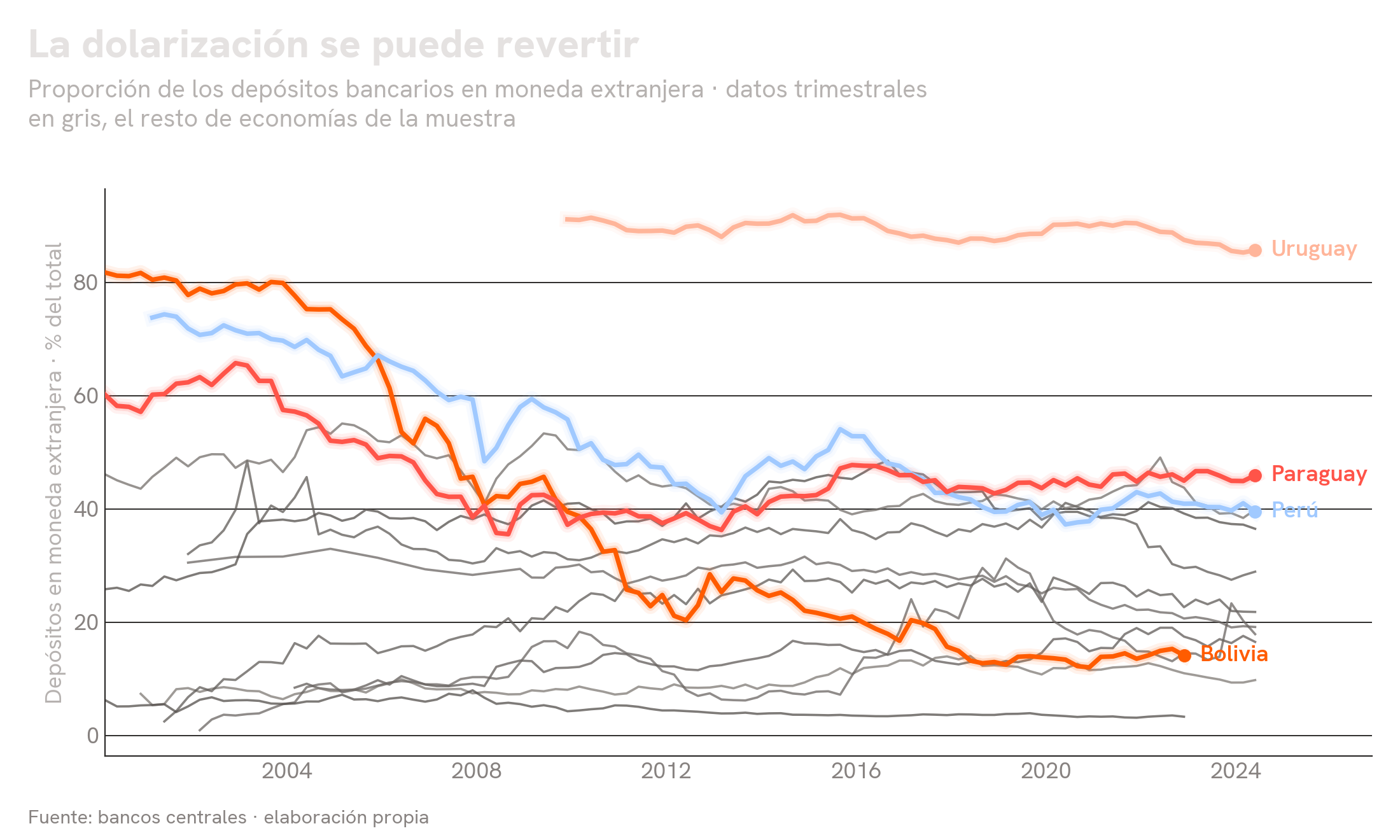
Bolivia is the extreme case of reversal and Uruguay the case of persistence. The difference was not a ban: it was a sustained combination of macro stability, credible appreciation of the local currency, and explicit regulatory costs on mismatch, maintained for years. Hysteresis describes inertia, not destiny.
The costs and the (few) benefits
- Monetary policy is lost: with high dollarization, the local interest rate moves little and the lender of last resort is constrained.
- Mismatch risk: households and firms that earn in pesos and owe in dollars turn every depreciation into a solvency problem — the balance-sheet channel.
- In exchange: immediate nominal discipline and elimination of exchange-rate risk in officially dollarized economies — with the bill of losing the countercyclical anchor.
What works to de-dollarize
The evidence favors market-based strategies over bans: sustained macro stability (a necessary but not sufficient condition), development of local-currency debt markets, prudential requirements that make the cost of mismatch visible (differentiated reserve requirements and provisions), and credible indexation as a bridge — the Peruvian case and the use of Chile's UF are the regional references. Forced de-dollarizations, by contrast, tend to produce deposit flight and disintermediation.
The agenda remains open: stablecoins reopen the door to dollarization — now digital and frictionless — and several economies in the region are again taking the temperature of their dollar deposits.
Three ideas to take away
- Dollarization is a portfolio decision, not a cultural trait: it responds to the relative volatility of inflation against the exchange rate.
- The inertia is real but reversible: Bolivia and Peru did it with stability, local-currency markets, and explicit costs on mismatch; Uruguay shows what happens without that.
- Banning does not work: forced de-dollarizations produce deposit flight and disintermediation, not confidence.
Note based on an original critical literature review (2025) — from Reinhart, Rogoff and Savastano (2003) and Ize and Levy-Yeyati (1998, 2003) to Castillo, Lama and Medina (2024) and Drenik and Pérez (2021). The figure uses quarterly deposit-dollarization data from central banks in the region.