Climate change and financial stability: why it is a macroeconomist's concern
Climate change is no longer a chapter in environmental reports; it has become a documented source of macrofinancial risk. The operational question for Latin America is not whether it affects stability — it is through which channels, at what speed and who finances the response.
Two risks, different clocks
The literature organizes the problem into two families. Physical risk — hurricanes, droughts, floods — destroys capital, interrupts production and hits the loan portfolios of banks exposed to the affected sectors and regions. The transition risk runs on another clock: shifts in policy, technology or preferences that reprice carbon-intensive assets — a risk that is especially serious for economies that export oil, gas, coal and mining products. Latin America has both: high physical exposure and export structures that are intensive in natural resources.
From climate to the balance sheet
The transmission channels are concrete: supply shocks that raise food prices and complicate the task of central banks; deterioration of loan portfolios after disasters; fiscal pressure from reconstruction just when revenue falls; and sovereign risk premia that already incorporate climate vulnerability — several studies document that the most vulnerable countries pay more for their debt, controlling for everything else.
A natural disaster is a classic macro shock, with an aggravating factor: it is ever less rare and ever less insured.
The "ever less rare" part can be measured. The figure counts, year by year, how many days exceed the heat threshold that each country considered exceptional in the first decade of the century — its own 95th percentile between 2000 and 2009.
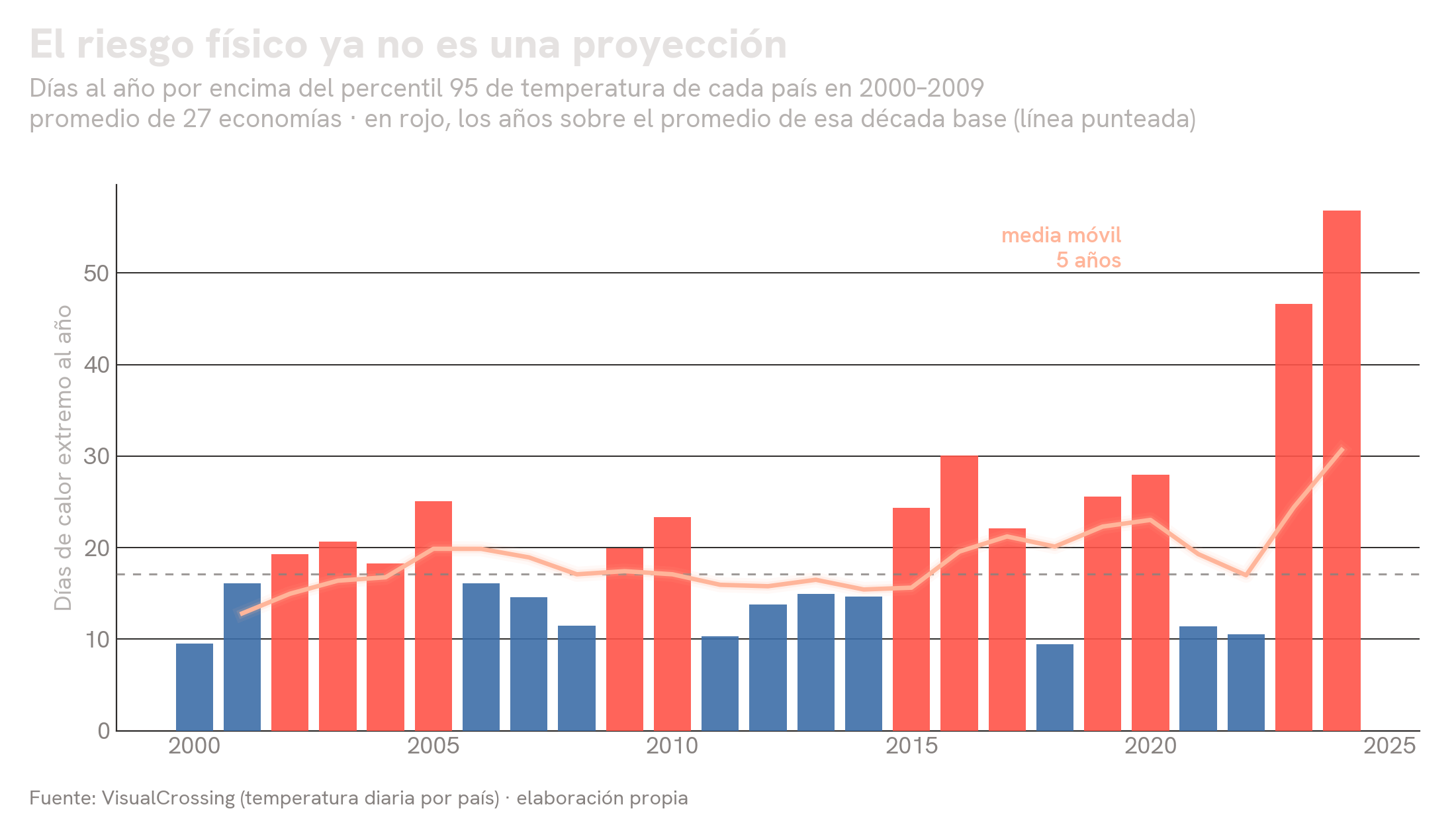
An actuarial assumption built on the historical frequency of an event ages badly when that frequency triples in two decades. That is, in a single image, the problem facing insurers, banks with agricultural portfolios and the finance ministries that budget for reconstruction.
The institutional link: the safety nets
Here a rarely discussed actor comes into play: the financial safety nets — the IMF, the regional financing arrangements (RFAs) and the central banks with their liquidity lines. Climate shocks are exactly the kind of event they exist for: balance-of-payments blows that are sudden, concentrated and uncorrelated with the affected country's poor macro management. The agenda under construction — which I worked on during 2025 — involves adapting instruments: contingent lines triggered by climate parametrics, coordination across the layers of the net and financing of adaptation before the disaster, which is systematically cheaper than reconstruction afterwards.
Three ideas to take away
- Climate risk is macrofinancial risk — it belongs in stability reports, not only in sustainability ones.
- Measurement comes first: without data on physical and transition exposure by country and sector, the conversation stays at the level of generalities.
- The safety nets need to be updated: the instruments designed for traditional balance-of-payments crises require adjustments for recurring climate shocks.
Note based on the author's own review of literature and seminars on climate change, financial stability and regional financial safety nets (2025). The figure uses daily temperature by country (VisualCrossing, 2000–2024).