The credit channel: how the Fed reaches your local bank
When the Federal Reserve raises rates, something changes on the balance sheet of a bank in Bogotá, Lima or Asunción before any local rate moves. That journey — from the policy decision to the credit a firm receives — is the bank lending channel, and in emerging economies it has an added layer: the dollar.
The basic idea
The textbook view holds that monetary policy operates through the interest rate: the cost of money rises, demand falls. The bank lending channel adds the supply side: when banks' funding becomes more expensive or contracts, banks lend less and to fewer clients, even the good ones. The effect is not uniform — it hits hardest the banks with less liquidity and capital, and the borrowers who cannot substitute bank credit with other sources: SMEs and households.
The emerging-market version: the dollar in the middle
In Latin America the channel has an additional floor. A large share of bank and corporate funding is in dollars, so the Fed's decisions and the global financial cycle move the supply of local credit without asking permission from the domestic central bank. When the dollar strengthens, balance sheets with currency mismatches deteriorate, external funding becomes more expensive and credit contracts — the global risk-taking channel operating through banks.
The empirical question is not whether the Fed affects credit in the region — it is which banks, which firms, and with how much lag.
Where the channel bites hardest
That additional floor is not equally deep everywhere. The figure measures how much of the bank balance sheet is denominated in foreign currency, country by country: on the left of each bar, deposits; on the right, credit.
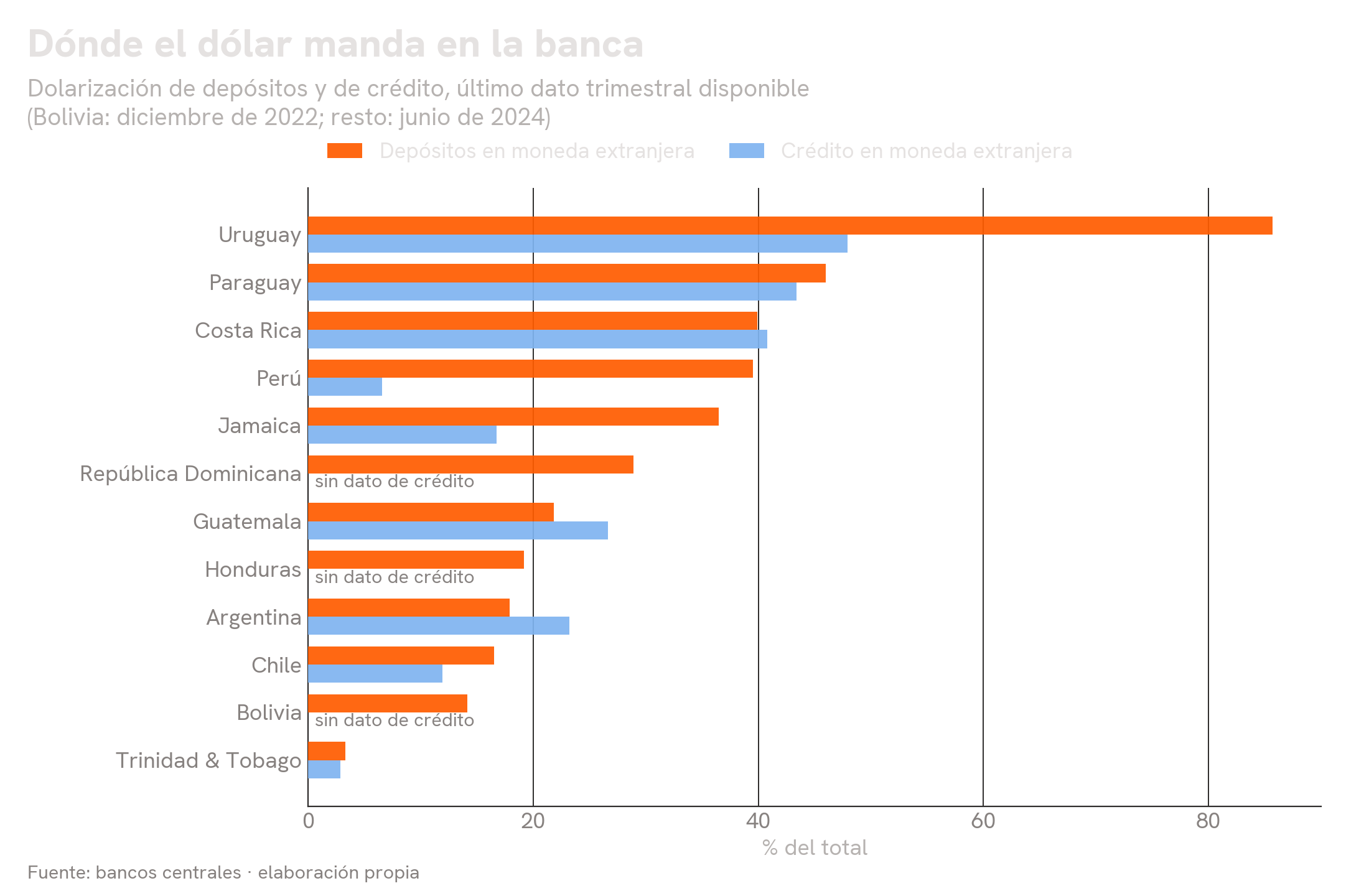
The reading is not that more dollars is worse, but that the transmission map is heterogeneous: where banking is heavily dollarized, the Fed enters the balance sheet directly and local policy fights against funding it does not control. Peru is the interesting contrast — deposits still 39% dollarized, but dollar credit of just 7%: the mismatch was absorbed on the asset side.
How it is studied (and what I found in the data)
Identification requires microdata: quarterly panels that cross banks and firms to separate credit supply from demand — the classic strategy of comparing how different banks respond to the same shock, lending to the same economy. In the exercise I built in 2024-2025 I assembled a quarterly panel of banks and firms from the region, crossed with Fed rates and exchange rates, to document the stylized facts of the channel: the response of credit to global tightening cycles is visible, heterogeneous across banks and stronger where the currency mismatch is larger.
Why it matters for policy
- Qualified independence: with a globalized credit channel, local monetary policy shares the wheel with the Fed — the famous dilemma (or is it a trilemma?) of open-economy macro.
- The buffer matters: better-capitalized banks with stable funding cushion the shock; prudential regulation is also countercyclical policy.
- Watch the balance sheets, not just the rates: monitoring the currency mismatch of banks and firms says more about transmission than any policy rate.
Note based on an original exercise (2024-2025) with a quarterly panel of banks and firms in Latin America, Federal Reserve rates and exchange rates. The figure uses data on the dollarization of deposits and credit from central banks in the region.